Great employees aren't born; they're trained! We make learning simple, enjoyable and cost-effective. With business noew recovering from the Covid-19 lockdown, we understand that your organisation may have a limited budget for learning and development. That's why we can help you and your people with live (classroom or virtual) or self-paced online via our e-Courses.

Confident and Credible Communication – Communication Skills Training

Home Courses Confident and Credible Communication – Communication Skills Training

Course Overview

communication

Confident and Credible Communication is practical communication skills training designed to help participants communicate with greater confidence, clarity and credibility in the workplace. Effective communication is more than simply choosing the right words — how we listen, speak, respond and use non-verbal communication can all influence how our message is received.

The course helps participants recognise common barriers to effective communication and understand their own communication style. They explore verbal, vocal and visual communication techniques, including body language, active listening, questioning and positive language, and learn how to build rapport with different people.

Participants also develop practical strategies for communicating persuasively, managing misunderstandings and responding more effectively during difficult interactions and conflict.

Confident and Credible Communication – Communication Skills Training is suitable for managers, team leaders and employees who want to communicate more effectively, build stronger workplace relationships and approach everyday conversations with greater confidence and credibility.
Key Learning Outcomes

By the end of this communication skills training, participants will be able to:

  • Recognise common barriers to effective communication and understand how they can affect workplace interactions.
  • Identify their own communication style and recognise the communication styles of others.
  • Understand the importance of verbal, vocal and visual elements in effective communication.
  • Use body language more effectively to support their message and build credibility.
  • Build rapport and establish stronger connections with different people.
  • Apply active listening techniques to improve understanding and communication.
  • Use effective questioning techniques to gather information and clarify understanding.
  • Use positive language to communicate messages more constructively.
  • Apply practical techniques to communicate more persuasively and influence others.
  • Respond more effectively when dealing with difficult or challenging interactions.
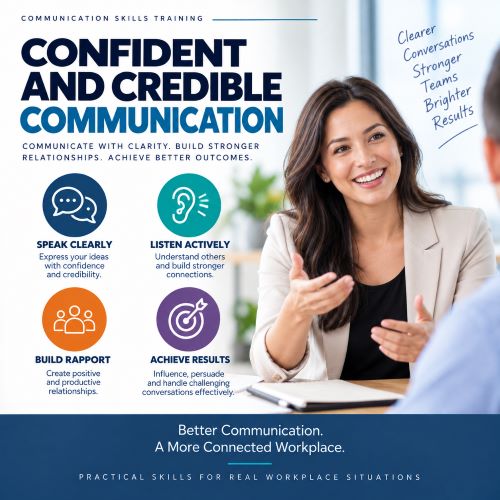
Communication skills training infographic showing confident speaking, active listening, rapport building and effective workplace communication

Training Outline

This practical communication skills training explores the techniques and behaviours that contribute to confident, clear and credible workplace communication. Participants develop practical skills in verbal, vocal and non-verbal communication, active listening, questioning, building rapport and adapting their communication approach when dealing with different people and challenging situations.

Morning Session
  • What is the purpose of all communication?
  • Why is good communication important in your workplace?
    Examples of effective and ineffective communication.
  • Who do you interact with, and what do your colleagues, manager, and customers expect of you?
  • The three ‘V’s of communication.
  • How people communicate.
  • Recognising the 4 basic communication styles and assess your own style at work.
  • The five axioms of conscious communication:
  • Rapport.
  • Effective listening.
  • Questioning skills.
  • Positive language.
  • Trust.
Afternoon Session
  • How to communicate to build rapport and openness.
  • Listening to learn, gaining information and creating conversational bridges.
  • Using the right verbal and nonverbal language.
  • How to positively persuade and influence people.
  • Defining a difficult interaction or conversation.
  • Why ‘tough’ interactions can quickly turn ‘pear-shaped’ (and how to stop them getting out of hand).
  • Resolving misunderstandings,
    disagreements and conflicts.
  • How to STATE yourself clearly
    (Share your facts, Tell your story. Ask for their view. Talk tentatively. Encourage testing).

Training Options

Confident and Credible Communication – Communication Skills Training can be delivered in a format that suits your organisation, team and training requirements. Whether your goal is to improve everyday workplace communication, strengthen relationships or help people communicate with greater confidence and credibility, the training can be tailored to suit your workplace and learning objectives.

Every organisation is different. Talk to us about your team’s communication challenges and what you would like participants to achieve. We can then discuss the most suitable training option for your organisation.

Schedule a phone call with us.

Delivery options include:

  • 1-day Training (7 hours)
  • Half-Day Express (3 hours)
  • Lunch & Learn (60 minutes)
  • Online Training (Self-paced)
  • One-on-One (Zoom) Coaching
  • Available training across Australia